Monday, 19 October 2015

Best eats in Korea: Not to be missed

Today is my last post about my favourite aspects of Korean cuisine. And the parts of Korean cuisine that I will write about today are not to be missed - mostly because you couldn't miss them if you tried!

You won't have to go far to find these beauties (once you've landed in Korea, that is). 

Kimchi


Now obviously I couldn't write about Korea without talking about kimchi - the traditional Korean favourite. 

Kimchi!

I know that fermented cabbage (or radish) doesn't sound like the most pleasant of food ideas (I can only imagine how the recipe was discovered....). But the first thing you should know is that it is much better than it sounds.

Although it is an acquired taste. While I was willing to polish off the lot at every meal (it was literally everywhere), Ross wasn't so convinced initially. It is an unusual taste, but by the end of our stay he was enjoying it.

You should also be forewarned that it's quite spicy. A Korean once described kimchi to me as "more spicy in the stomach than spicy in the mouth" - you get the idea. 

But maybe that "spicy in the stomach" characteristic is part of the appeal? Kimchi is fermented, so it's full of probiotic goodness, which means that it promotes good gut bacteria and helps with digestion. 

And it's delicious - well, at least I think so!

Street food


Korea is a shopping metropolis - but hunger won't hold you back. Street food is available in many of the main markets and shopping areas. And it's awesome. 

Now maybe I am stating the obvious. Street food is awesome everywhere, right? Everything tastes better deep fried, after all. But the cool thing about Korean street food is that it isn't all just deep fried on a stick. 

You will find fruit, roasted chestnuts, corn cobs, and barbecued squid - all of which are great for cheap, tasty gluten-free snacks. 

And if you want something deep fried on a stick, well, they have that too. 

Deep fried potato (and a slightly scary eating face...)

The best of the West


Korea has mastered some of the best treats from Western cuisine. 

In fact, not only does Korea do the best of the West - in some cases, it's better. Take blueberry lemonade, for example. It might actually be the most amazing thing ever. 

In Korea you'll find lots of fun, exciting drinks everywhere you go, no matter the time of year - flavoured lattes in winter and fruit teas in the sweltering heat. And for every sort of craving imaginable, too.

Now, to be fair, not all these inventions are good ideas - sweet potato and avocado lattes were not on my list of things to try, and cold americanos are dreadful. (DON'T TRY IT. Worst mistake.) But most of the time, the quirky drinks in Korea are a delightfully sweet experience. 

Mango smoothie and refreshing lemonade.

So while there's heaps of wonderful Korean cuisine to try, you'll still have some of the comforts of home. There's familiar coffee chains and fast food all over the place (I was pretty grateful to have Starbucks nearby when my cravings for a soy latte became too much). 

And it was in Seoul, with the help of a couple of lactase tablets, that I discovered the very best that western food has to offer: Baskin Robbins. 

It really will knock your socks off - and in 36 flavours!

In fact, there's only one thing that could beat it. And in my next post that's exactly what I'll be writing about!

The best of the West.

For more about eating in Korea, check out A bit moreish's travel page here.

Tuesday, 6 October 2015

Best eats in Korea: Just how you like it

What could be more delicious than meat cooked to perfection right in front of your eyes? 

Korean barbecue. That's what. 


Sure, the meat is really delicious. I mean seriously delicious. But Korean barbecue is about so much more than that.

Korean barbecue can make even the cheapest cuts of meat deliciously juicy and tender. In fact, we found the cheaper cuts were actually better. Does barbecued scotch fillet sound pretty good? Don't bother. Short rib is a third the price and, when it's served off the hot plate, it's twice as tasty. Usually thinner slices of meat are better, too. 

The key thing is that the plate is super hot, so everything cooks quickly - the fat renders perfectly but the meat is still tender. 


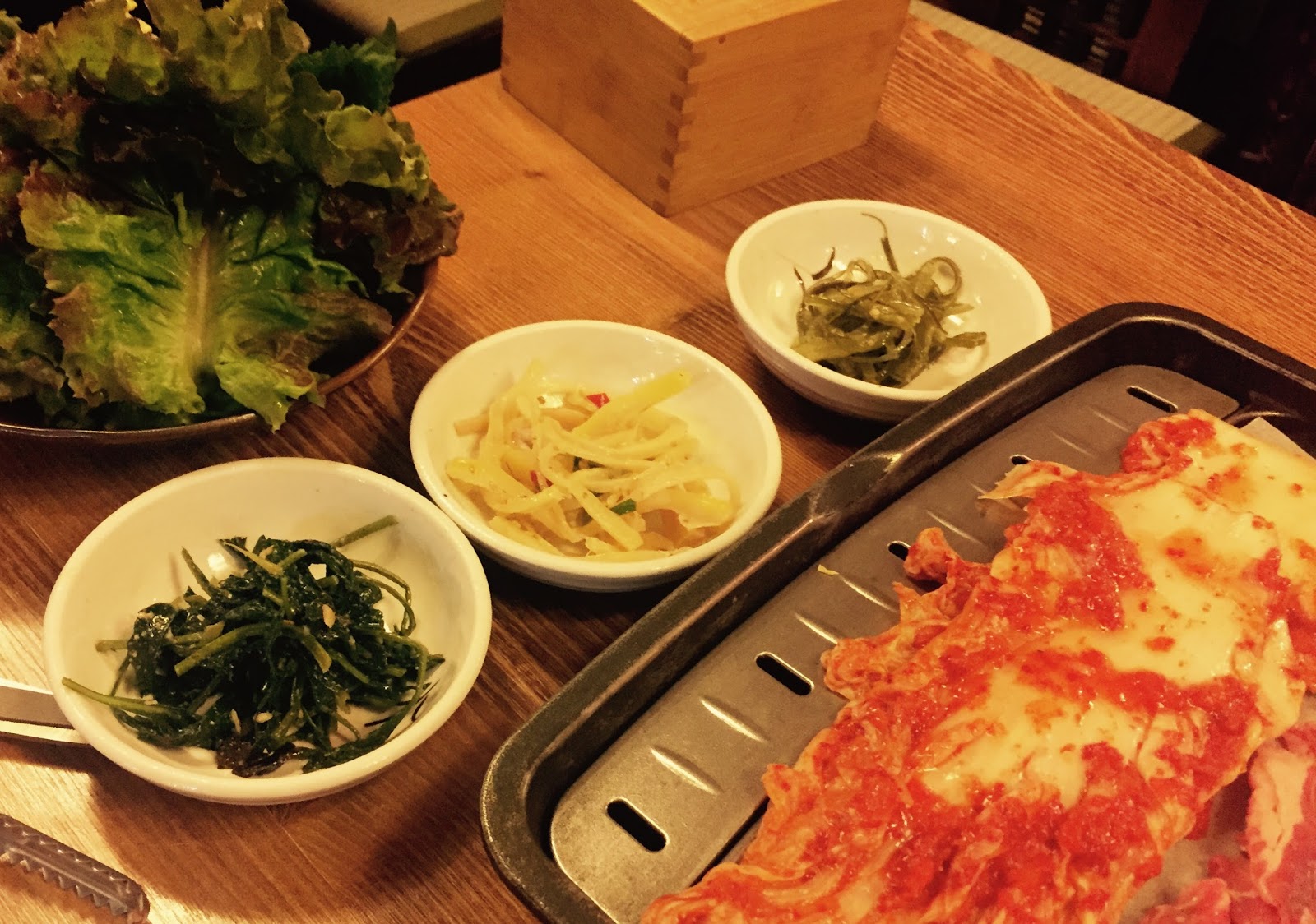
The cooking about to begin!

Korean barbecue comes with more sides than I could possibly describe here - and it amazed us that every restaurant gave us something a little bit different. The range of condiments always showcased a range of delicious vegetables, textures and flavours. And, if there was something we particularly liked, our bowls were refilled without us even having to ask.


So many yummy sides!

There were also big lettuce leaves that we could use to make lettuce wraps from the meat and sides. I never really got the hang of making them, to be honest, and usually ended up with pickle in my lap. And yet eating the lettuce by itself with chop sticks wasn't straightforward, either - so it was best to just embrace the hilarity (and the pickle, I suppose). 


But all the tasty aspects aside, the best thing about Korean barbecue is that it's communal. We got to cook the meat ourselves with some much-needed guidance from our hosts. And it was just how we like it. 

By the end of our trip, we were real pros. Well, we thought so. 

We certainly had heaps of fun trying!

Me enjoying the deliciousness.

Oh, silly me, did I mention it's also gluten free?

Well, usually. Always check with the language cards - these are a must - so that you can avoid sauces with gluten in them and meat marinated in soy sauce (e.g. bulgogi).  

Despite the language barrier, we had absolutely no problem finding Korean barbecue everywhere we went. 

And, hey, who doesn't love succulent pork belly for dinner every night? 

Sunday, 27 September 2015

Guest post: What the gluten-free diet isn't

Recently I got the awesome opportunity to contribute a guest post for Glutey Girl. And here it is! 

Check out this link for my musings on common misperceptions about the gluten-free diet (plus the recipe for my decadent 'cream cheese' bagels).


Thursday, 24 September 2015

Best eats in Korea: A healthy appetite

There are many exciting aspects to the food available in South Korea - and many that sadly aren't gluten free. But while eating gluten free in Korea can be tricky at times, there's no need to miss out on all the deliciousness that Korean cuisine has to offer. 

During the next few posts, Il'll take you through what I consider to be the best aspects of the cuisine we tried in Korea - which you can enjoy without all the gluten. 

And here's the first.


So. Many. Vegetables. 


Korean cuisine offers a vast array of wholesome, healthy dishes. The meals are - in my completely non-expert opinion - quite balanced, with delicious proteins and a variety of fresh vegetables. Sure, there's a lot of white rice, but the serving sizes are always quite modest. 

Sometimes we had to have vegetarian meals to avoid marinated meat, so I did have to be careful to ensure I was getting enough iron. But, apart from that, I was really impressed by how nutritious the authentic Korean dishes seemed.

Our favourite lunch choice was Bibimbap, which literally means 'mixed rice'. The dish consists of a range of vegetables and seaweed, served with rice in a big bowl then topped off with an egg (and sometimes meat). 

Hot stone Bibimbap.

Everything is then stirred together just before eating. 


Mixing the rice without flinging it all over the table - an acquired skill.

Bibimbap comes hot or cold, but we liked the hot one especially. The sizzling hot stone pot makes the rice caramalize so that it is deliciously chewy and the warmth gives the dish a real homely feel. 

Traditionally the dish comes with spicy gochujang sauce, which isn't gluten free - so we had to give that a miss. Now, given this omission, the dish might sound simple and maybe a bit boring. But the seaweed and egg yolk add a tasty, salty edge that really brings out the blend of flavours in the dish. Making it simple, healthy - and incredibly tasty. 

So tasty.

Tuesday, 22 September 2015

Travelling gluten free: A different adventure of the food kind

You might have wondered why I haven't posted in a while. Or maybe you didn't notice. Or maybe you enjoyed the break from my eternal monologue about gluten-free meals and digestive problems.

Well, I'm back. And back from somewhere pretty amazing. Ross and I have just returned from a trip to South Korea and Hong Kong, where we saw the sights and enjoyed some delicious treats on the way. 

Over the next few posts I will share with you some of the different aspects of our food adventures, starting with our travels in Seoul and Busan - South Korea's two largest cities.


Overlooking the city by the love locks at N Seoul Tower.

Now, full disclosure - in case you're suddenly feeling inspired to jump on a plane to Seoul - eating gluten free in Korea can be quite hard. 

To be honest, I wouldn't recommend a trip to Korea if you are highly allergic to gluten - it's possible to avoid gluten when eating out, but doing so is risky. Thankfully, we didn't have any known gluten reactions during our stay, but it seemed like we could be inadvertently poisoned quite easily. And I came armed with a packet of peppermint capsules in case of that eventuality. 

Sure, we were very careful with what we ate, but there's a limit to how paranoid you can be when the language barrier only allows you to say so much - and the sneaky sources of gluten in food make this quite complicated at the best of times!

When eating gluten free in Korea, you have to be willing to work for your next meal - and by 'work' I mean visit lots of restaurants, get creative in your communication, and spend a decent amount of time just searching the streets.  


Searching the streets of Seoul.

But boy is it worth it. 

To ensure we didn't starve, we went armed with the info from this blog and this nifty travel card. The Korean travel card is particularly good because it highlights a range of gluten-containing ingredients that are common in Korean cooking. 

We asked lots of questions, went somewhere else if we weren't sure, and trusted the travel cards - not to mention the immense effort made by our hosts. 

Koreans are very hospitable people and they were always very attentive when we made our needs known. They would analyse each part of the dish and its (typically numerous) sides. Then they would double check with us if they weren't sure about anything, and take away parts of the meal or turn us away entirely if the food wasn't suitable.

Interestingly, while eating gluten free was tricky, minimizing my consumption of high-FODMAP foods didn't really add any extra complications. All I needed to do was strategically consume lactase tablets on the odd occasion and avoid the enormous garlic and onion pieces we were offered as a side to many dishes.

Despite the effort that it took to eat, we never went hungry. In fact, the food was delicious - as I will show you in coming posts.

And remember, there's no need to jump on a plane, or even take my word for it - amazing gluten-free Korean food can be found right here in Wellington.

Saturday, 22 August 2015

The royal treatment

It's really important to celebrate. 

On Thursday night, Ross and I went to our favourite haunt to celebrate a busy but successful week of work - along with my rekindled relationship with garlic and onions.

Royal Thai is our favourite restaurant if we have something to celebrate. We often go there for anniversaries, work successes, birthdays - anything of significance. 

It's our favourite because it's sentimental to us - and delicious. The food is full of fresh, sensational flavours. Just the right amount of spice without being greasy or heavy. 

There's plenty of variety, too. We love the Pad Thai, Pad Phrik King, and Kaeng Mussaman Nau. But everything we have tried has been excellent. We usually have two dishes, a rice each, and share.

Chicken Pad Thai.

Pork Pad Phrik King.
Royal Thai isn't expensive; it's just special.

A meal will only set you back $20 a head, meaning you can splash out on a special bottle of BYO wine to match the occasion - we recommend a riesling or gewurztraminer to complement the vibrant Thai flavours. 

Plus the service is great. And they cater for gluten-free diets - just ask. I can even eat there on my low-FODMAP diet by avoiding high-FODMAP vegetables, altough you may need to be careful if you are sensitive to onions and garlic. 

The only downside is that Royal Thai is a bit of a walk from us. But I suppose that is probably a good thing. If it was any closer, we would probably go there every week. 

And that wouldn't be quite so special, would it? 

Living the dream.

Sunday, 9 August 2015

Time to explain myself

On Friday, I had an appointment with Sarah, my dietitian, to discuss my low-FODMAP diet now that we know what foods trigger my irritable bowel symptoms. 

I am now at a point where I can gradually start re-introducing or increasing my intake of certain foods. And the thought of trying some of my favourites again is pretty exhilarating, which might seem a tad dramatic, but after two months without aioli, trying it again is pretty big deal. 

The point is, I can now find my 'new normal'. (Of course, I use the term 'normal' here very loosely.)

And as it turns out, the hardest thing about this new normal - because eating aioli certainly isn't difficult - has been explaining exactly what that new normal is. 

Talking about low-FODMAPs is one thing. But explaining my version of low-FODMAPs is even harder. People have been extremely supportive during my journey and it's nice to have opportunities to explain myself to those who are interested. But finding the right words is another matter entirely.

"It's changed my life", while accurate, doesn't convey enough information. But "here's a monologue on gastroenterology..." doesn't quite work either. 
  
It's a balance between having a simple explanation - so that I don't put people to sleep or, worse, put them off their dinner - and making sure that I don't shy away from the reality of my digestive problems. 

Because my reality might resonate with someone else. 

Irritable bowel syndrome (or IBS) affects about one in every six people (yes, really), which means that every person I talk to either knows someone with IBS or is struggling with it themselves. 

So, while explaining my diet might be (ok, definitely is) embarrassing, it's a conversation that might be needed. (Of course, a conversation can only get you so far - treatment of IBS should always be overseen by a doctor and / or a dietitian. See the Monash University app for more information about the low FODMAP diet.) 

Through trial and error, I've got my new normal summarised down to three sentences. Here are those three sentences explained. 

I am gluten intolerant, but I am also on a low FODMAP diet to manage the symptoms of IBS.


Irritable bowel syndrome is very common, but the symptoms and their severity can very a lot between individuals. For me, IBS means excruciating stomach pains. The low-FODMAP diet helps me to alleviate these pains and encourage normal bowel function. In fact, the low-FODMAP diet has been shown to improve symptoms in 76 percent of people with IBS. 

FODMAPs - or Fermentable Oligo-saccharides, Di-saccharides, Mono-saccharides and Polyols - are a group of sugars. For many people with IBS, some or all of these sugars are malabsorbed in the small intestine, leading to digestive discomfort. 

The low-FODMAP diet limits the intake of these sugars (the 'elimination phase'). Then, if symptoms are alleviated, the sugars are then re-introduced one by one to identify individual triggers (the 're-introduction phase'). Once these triggers are known, the diet is customised to achieve symptom control (the 'normalisation phase').  

This means that I can't digest certain foods properly (for example, apricots, milk and honey). 


FODMAPs are in a wide range of foods that fall under six broad categories. Here are some examples of foods that are high in FODMAPs.
Fructose (in excess of glucose) - honey, fruit, especially dried fruit or juice, and some vegetables 
Lactose - milk products (but not all dairy products - cheese and butter are ok)
Sorbitol - some fruit (e.g. apples, pears, blackberries, apricots, nectarines, plums), vegetables (e.g. avocado) and artificial sweetener  
Mannitol - some fruit (e.g. watermelon), vegetables (e.g. cauliflower, mushrooms, snow peas) and artificial sweetener  
Fructans - garlic, onions, wheat, rye and barley (and some other fruits and vegetables)
GOS (galacto-oli-saccharides) - legumes, such as chickpeas (and some other fruits and vegetables)

The elimination and re-introduction phases that I have been through have revealed which of these six broad categories are my triggers. 

It turns out that I malabsorb sorbitol, lactose, and fructose, especially sorbitol. Apricots are NOT my friend.  

On the plus side, I can tolerate mannitol, fructans and GOS pretty well. This means that, among other things, I do not have to live without aioli. 

Interestingly, I can absorb the sugars in gluten-containing foods (i.e. fructans) fine, which means that I am intolerant to gluten itself (the protein) rather than the FODMAPs in these foods. This confirms that my gluten intolerance is a very separate issue. 


But while I have to strictly avoid gluten, I just need to limit my intake of FODMAPs. 


Due to the potentially-damaging effects of my gluten intolerance, I have to be very strict in avoiding gluten. But that is not the case with FODMAPs - I'm not trying to cut them out entirely.

Foods that are high in FODMAPs are good for you nutritionally and eating them is not damaging. The diet is about symptom management, not exclusion. Tolerance for the different sugars can also change over time, so it's important to be continually re-testing tolerance levels to get the most enjoyment and nutritional value out of the diet.  

Mindfulness is important when it comes to managing symptoms. The effects of eating FODMAPs are cumulative, so it is important to be aware of how much of each FODMAP you are eating - even the ones that don't tend to cause you problems - and how they might interact. 

Non-dietary factors are important too - on one hand, stress and hormonal fluctuations can exacerbate symptoms. On the other hand, dietary supplements can help.  Probiotics and lactase enzymes can help enhance tolerance, and peppermint capsules can help with symptom management. 

Burger Fuel gluten-free C N cheese burger with aioli (but no onions).

So this is where my version of the low-FODMAP journey starts. 

I'll be sticking to my rice porridge, back to eating aioli sometimes, and avoiding apricots like the plague - with lots of other food groups in between. 

I'll be cutting back on lactose, except on the odd occasion (as in, I'll be eating a whole packet of lactase tablets at Christmas to enjoy our delicious family traditions). 

When I'm eating out, I won't be as strict as I have been, so some of my blog posts won't be relevant for everyone's version of the low-FODMAP journey (but I'll give you information where I can). 

Most of all, I'll be feeling my way as I go - discovering my limits and eating lots of delicious treats on the way.

I hope you'll join me on the next phase of my journey.